
Toy vs Miniature vs Standard vs Teacup Poodle: Full Size Guide for Indian Buyers

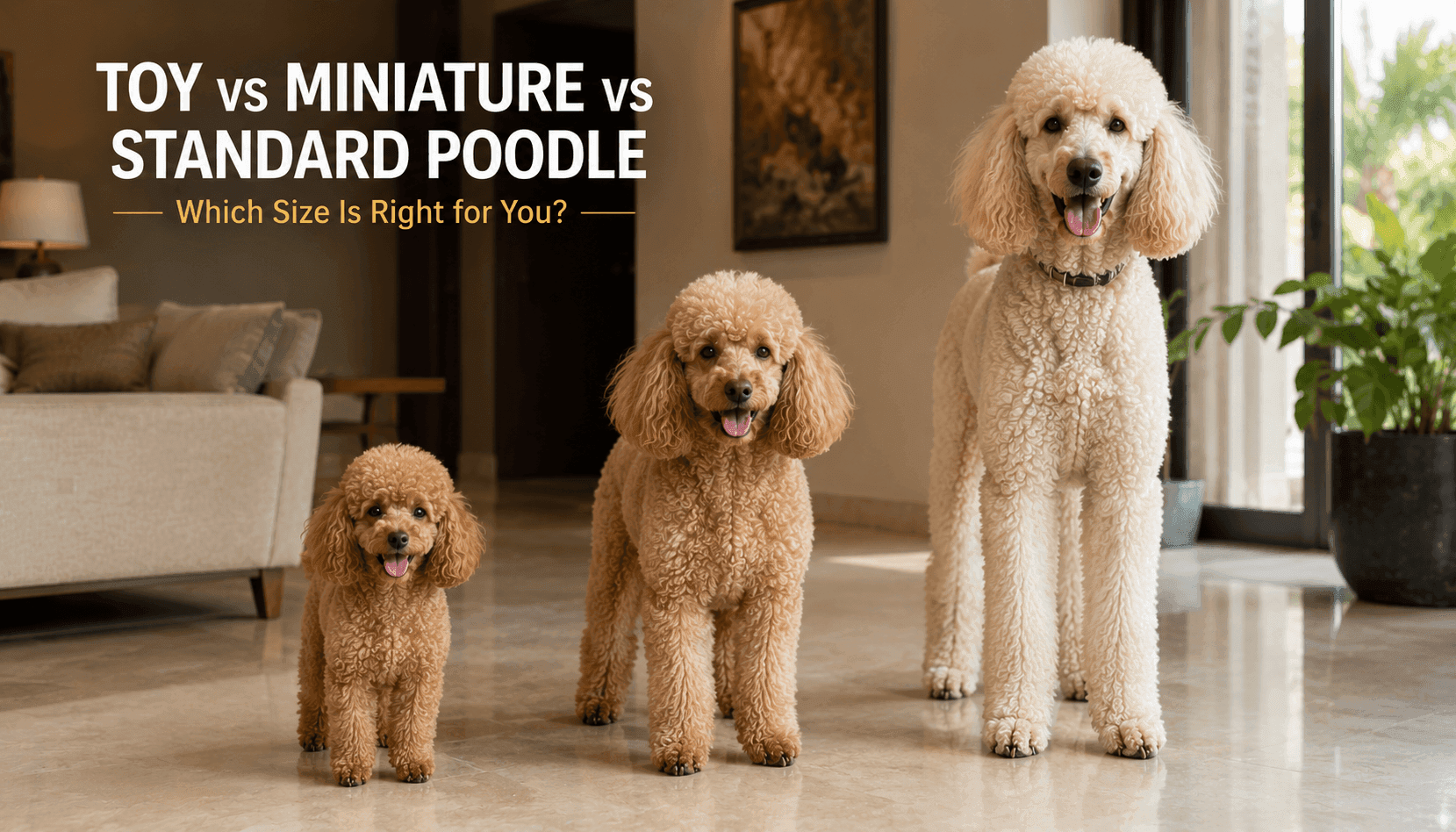
You're browsing Poodle listings and the terminology doesn't line up. One seller calls a puppy "Toy," another calls a similar-looking puppy "Teacup," a third throws in "Miniature" without explaining what separates it from the first two. If you're trying to figure out which Poodle size is actually right for your home in India, the inconsistent labeling online makes a simple decision feel confusing.
Here's the short version: size is only one factor in choosing a Poodle, but it's an important one — it shapes space needs, exercise routine, grooming time, how the dog interacts with children, and what you can realistically budget for. This guide walks through each recognized Poodle size, explains where "Teacup" actually fits into the picture, and gives you a practical way to match a size to your lifestyle rather than to a listing photo.
Poodle Sizes Explained at a Glance
Poodles are officially recognized in three sizes — Toy, Miniature, and Standard — categorized mainly by adult height. "Teacup" is not one of them; it's a marketing term used for Poodles bred smaller than the typical Toy range, without a formal breed standard behind it.
| Variety | Adult Height | Typical Weight | Energy | Grooming | Space | Best For |
|---|---|---|---|---|---|---|
| Toy Poodle | Up to ~10 inches | ~2.5–4.5 kg | Moderate | High | Compact | Small homes, calm households |
| Miniature Poodle | ~10–15 inches | ~5–8 kg | Moderate–active | High | Apartment to mid-size home | Active families wanting a manageable size |
| Standard Poodle | 15+ inches (often 18–24") | ~20–32 kg | High | High (more coat) | More room to move | Active households, experienced owners |
| "Teacup" Poodle | Below Toy range | Often under 2.5 kg | Moderate, but fragile | High | Same as Toy, more caution needed | Not a recommended default — evaluate health first |
Individual dogs vary, so treat these as general ranges, not guarantees for a specific puppy — and note that height and weight don't always scale together in exact proportion.
Toy Poodle — Small in Size, Big in Personality
The Toy Poodle is the smallest recognized size, typically reaching up to about 10 inches at the shoulder as an adult. Despite the compact frame, Toy Poodles are alert, quick learners, and often strongly bonded to their families — they carry the same intelligence as the rest of the breed.
Temperament, training and exercise: Small size doesn't mean low maintenance. Toy Poodles need consistent training, daily mental stimulation, and short but regular walks and play sessions. Left under-engaged, they can become anxious or overly attention-seeking.
Grooming: Their coat needs regular brushing and periodic professional trims — this applies to every Poodle size, not just larger ones.
Apartment, children, and climate fit: Toy Poodles are often a practical apartment choice in Indian cities because of their size, but supervision around young children matters — their small frame makes them more vulnerable to accidental injury from rough handling. In peak summer heat, shorter, well-timed walks work better than prolonged outdoor exposure.
Price factors: Toy Poodle pricing in India depends on breeder reputation, pedigree, parent health screening, and location — covered in more detail later in this guide.
Miniature Poodle — A Middle Ground?
Miniature Poodles fall between Toy and Standard, generally standing 10–15 inches tall. They tend to be playful, energetic, and highly trainable, making them a common middle-ground pick for households wanting an active dog without a Standard's space requirements.
How they differ from Toy Poodles day-to-day: Miniatures are usually a bit sturdier physically, which can make them slightly better suited to homes with children still learning gentle handling — though supervision is still necessary regardless of size.
Exercise and trainability: They need daily walks plus play, and their intelligence makes them responsive to training, which is one reason they're often recommended to first-time owners willing to stay consistent.
Apartment and family suitability: Miniatures generally adapt well to apartments when exercise needs are met, though they benefit from a bit more room than a Toy Poodle typically needs.
Price factors: As with other sizes, pedigree, documentation, and health screening drive cost more than size alone — confirm current figures directly with verified breeders.
Standard Poodle — Is Bigger Actually More Difficult?
Not necessarily. The Standard Poodle is the largest recognized size, generally exceeding 15 inches and often reaching 18–24 inches, with an athletic, working-dog build. Higher energy and exercise needs come with the size, but that doesn't automatically make them harder to own — it just changes what "care" looks like.
Temperament and family life: Standard Poodles are frequently excellent family dogs — patient, gentle, and highly trainable — provided they get adequate daily exercise and structured training. Their size and energy mean children should be taught calm, controlled interaction.
Space, exercise, and mental stimulation: They need real daily exercise commitment — brisk walks, play, and mental engagement — to avoid boredom-driven behavior, and they do better with more room to move than a cramped apartment allows.
Grooming and Indian weather: Grooming takes longer simply due to more coat area. In Indian summers, exercise scheduled for cooler parts of the day, with consistent water and shade access, works best.
Price factors: Pricing again depends on pedigree, documentation, and breeder practices rather than one fixed number.
What Exactly Is a Teacup Poodle?
A "Teacup Poodle" is generally a marketing term for a Poodle bred smaller than the typical Toy range — it is not an officially recognized separate Poodle variety alongside Toy, Miniature, and Standard.
Why the term exists: Sellers use "Teacup," "Micro," or "Ultra-mini" to market unusually small puppies, sometimes as a premium or rare category. There's no formal breed standard defining this size.
Why unusually tiny puppies need careful evaluation: Extreme smallness in dogs can be associated with real health and welfare concerns — fragility, skeletal issues, and other complications — though this isn't automatic for every small puppy. It's a reason for added scrutiny, not automatic rejection.
Why buyers shouldn't choose based on tininess alone: A puppy advertised as "teacup" isn't inherently higher quality. What matters is verified vaccination and deworming records, a veterinary health check, transparency about the puppy's parents, appropriate age at sale, and a breeder willing to answer questions openly — not how small the puppy looks in a photo.
Toy vs Miniature vs Standard Poodle — Which One Is Right for You?
| Factor | Toy | Miniature | Standard |
|---|---|---|---|
| Size | Smallest | Mid-sized | Largest |
| Weight | ~2.5–4.5 kg | ~5–8 kg | ~20–32 kg |
| Energy | Moderate | Moderate–active | High |
| Exercise | Short daily walks | Daily walks + play | Daily exercise + stimulation |
| Grooming | High | High | High (more coat) |
| Training | High trainability | High trainability | High trainability |
| Temperament | Alert, attached | Playful, energetic | Patient, gentle |
| Apartment living | Well suited | Suited with exercise | Needs more space |
| Families/children | Supervision needed (fragility) | Supervision needed | Good fit with training |
| Travel | Easiest | Manageable | Needs more planning |
| Overall maintenance | High | High | High |
Toy Poodle may suit you if you have limited space, want an easily transportable dog, and can still commit to daily training and grooming.
Miniature Poodle may suit you if you want an active, trainable companion that doesn't need a large house, and you can manage daily exercise consistently.
Standard Poodle may suit you if you have more space, an active routine, and time for a bigger daily exercise and grooming commitment.
No size is universally "best" — the right choice depends on your space, schedule, and family situation, not on picking the "top" option.
Which Poodle Size Is Best for Indian Homes?
Across cities like Delhi NCR, Mumbai, Bangalore, Hyderabad, Pune, Chennai, Kolkata, and Chandigarh, the practical considerations are similar even if apartment sizes and climates vary slightly: summer heat, indoor cooling, access to outdoor space, and availability of a reliable groomer all matter more than picking a size because it's supposedly "made for India."
Toy and Miniature Poodles are often easier to manage in smaller apartments, but a Standard Poodle can do well in the same city if the household has more space and commits to proper daily exercise. Exercise timing (early morning or evening during peak summer) matters for every size, not just larger dogs. No single Poodle size is inherently better suited to India's climate — good management matters more than size alone.
Which Poodle Is Best for Apartment Living?
Toy Poodle: Compact and manageable in small spaces, but still needs structured exercise and mental stimulation — not just indoor confinement.
Miniature Poodle: Adapts well to apartments if daily walks and play are consistent; benefits from slightly more room than a Toy.
Standard Poodle: Can live in an apartment but needs meaningful daily outdoor exercise and more space to move comfortably indoors.
Does a smaller Poodle always mean less work? No. Regardless of size, every Poodle needs daily engagement, training, and grooming — a smaller dog is not automatically a lower-effort dog.
Which Poodle Size Is Best for Families With Children?
Toy Poodle: Intelligent and affectionate, but their small frame makes them more vulnerable to injury from rough or accidental handling — close supervision with young children is essential.
Miniature Poodle: Often a practical middle ground for families with children old enough to understand gentle handling.
Standard Poodle: Generally patient and gentle, but their size and energy mean children need to be taught calm interaction and consistent boundaries.
Across all sizes, young children should always be supervised around puppies and dogs, and taught gentle handling from the start — no breed or size should be assumed safe to interact with unsupervised.
Poodle Price in India by Size
There's no single fixed price for any Poodle size — cost depends on breeder reputation, pedigree, KCI registration or documentation where applicable, parent health screening, vaccination and veterinary care already provided, location, coat colour, and puppy age.
As a general pattern, more extensively documented and health-screened puppies tend to cost more, while unusually cheap listings — especially "Teacup" puppies — deserve extra caution rather than being seen as a good deal. For current, verified pricing by size, see our dedicated Poodle Price in India guide.
What Should You Check Before Buying a Poodle Puppy?
- Puppy's age (avoid puppies separated from their mother too early)
- Vaccination and deworming records
- A veterinary health examination, ideally documented
- Information about the parent dogs' health
- The puppy's living conditions before sale
- Breeder transparency — willingness to show the puppy and, where possible, its parents
- Registration/documentation where applicable (e.g., KCI)
- Evidence of early socialization
- Any contract or health guarantee offered
- Caution with unusually low prices, especially for "Teacup" or "micro" labeled puppies
- No pressure to pay immediately before you're ready
An unusually low price or an extremely small advertised size should never be treated as a good deal on its own — both are reasons to ask more questions, not fewer.
How to Choose the Right Poodle Size for Your Lifestyle
Choose Toy if your priority is a compact, easily manageable dog and you can still commit to daily training and grooming.
Consider Miniature if you want an active, trainable companion suited to moderate living spaces.
Consider Standard if you have the space and daily time for a larger, high-energy dog.
Be cautious with "Teacup" claims when there's no health documentation, the price seems unusually low, or the seller can't be transparent about the puppy's parents and breeding background.
Do Different Poodle Sizes Have Different Care Needs?
Feeding portions, exercise duration, and grooming time scale with size — a Standard Poodle eats more and needs more coat maintenance than a Toy. But training, mental stimulation, socialization, and veterinary care are non-negotiable at every size. All Poodles require consistent care regardless of how small or large they are — none of them are a "low effort" option simply because of their size.
Most read


Related Blogs
Male vs Female Puppy: Temperament, Size & Price Differences by Breed
Male vs female puppy guide: temperament, size and price differences by breed for Indian buyers. Get help choosing the right puppy with GoodFurs.
Frequently Asked Questions
Poodles are officially recognized in three sizes — Toy, Miniature, and Standard — based mainly on adult height. "Teacup" is a marketing term, not an official fourth size.