
Pure Beagle vs Mixed Beagle: How to Tell the Difference (2026 Guide)

Priya still remembers the day she brought Bruno home. The breeder had called him a "pure Beagle, KCI quality," and at ten weeks old, with those floppy ears and that classic tri-colour coat, nobody in the family doubted it. It was only at Bruno's first vet visit — six months later, when he was noticeably taller than every Beagle photo Priya had saved on her phone, with a leaner body and a bark that didn't quite match the breed's famous howl — that the vet gently asked, "Are you sure this is a purebred?"
He wasn't. Bruno was, and still is, a wonderful dog. But Priya had paid pure-Beagle prices for a mixed puppy, and more importantly, she'd made decisions about his diet, exercise, and training based on breed traits he didn't actually have.
This is more common in India than most first-time buyers realise. Beagles are one of the most in-demand breeds in the country, and demand always attracts shortcuts. Knowing the difference between a pure Beagle and a mixed Beagle isn't about snobbery or breed purism — it's about health predictability, temperament predictability, and paying a fair price for what you're actually getting. A pure Beagle comes with a known health profile, a known temperament, and a known adult size. A mixed Beagle can be a fantastic pet too, but you're working with fewer guarantees, and you deserve to know that going in.
This guide breaks down exactly how to tell them apart — physically, behaviourally, and on paper — before you commit.
What Is a Pure Beagle?
A Pure Beagle is a dog that meets the official Beagle breed standard on both sides of its pedigree, with no other breed introduced in its recent ancestry. In India, this is formally recognised through KCI registration (Kennel Club of India), which verifies a puppy's parentage against KCI's own breed records.
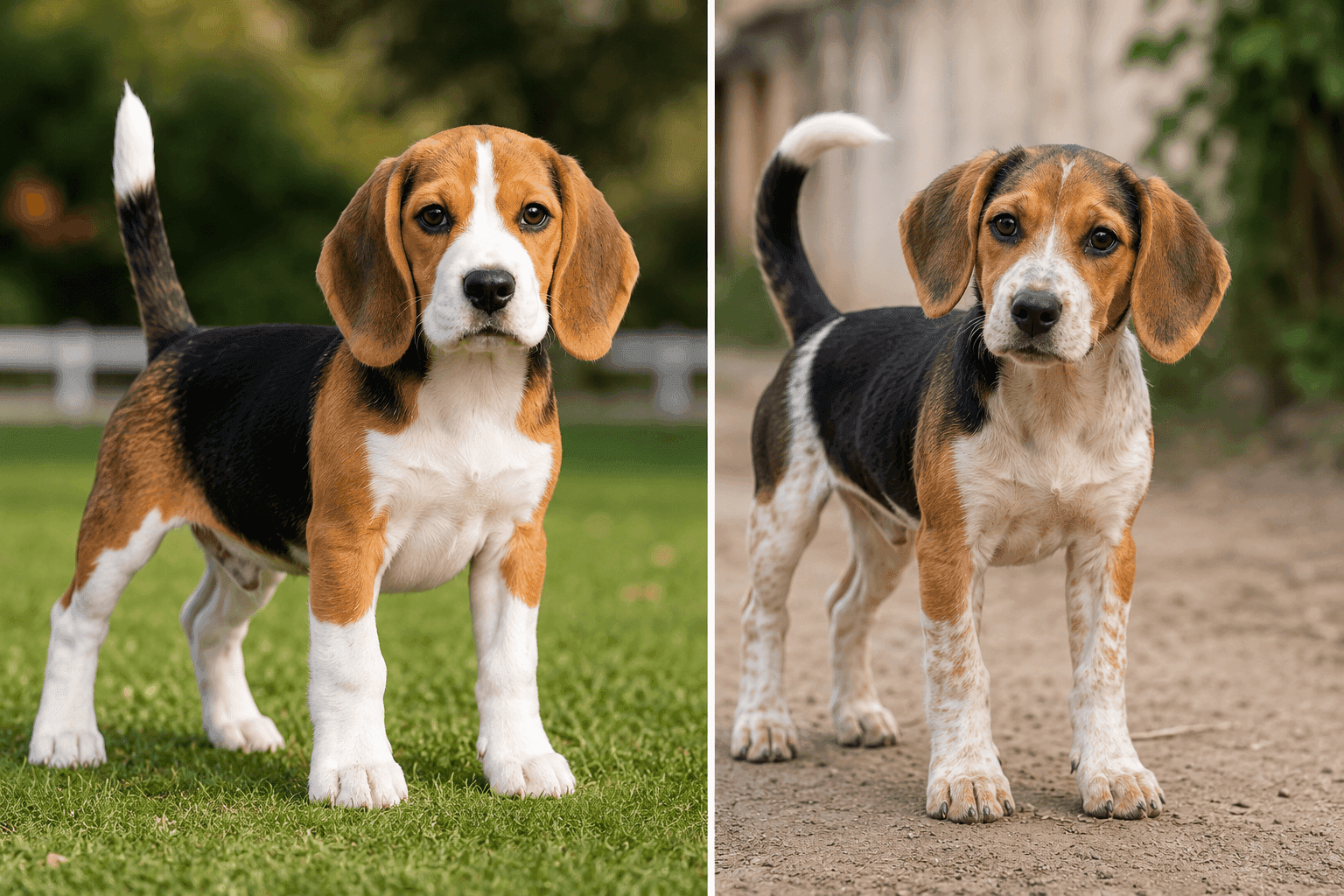
Breed standard traits of a true Beagle include a compact, sturdy body (typically 33–40 cm at the shoulder), a square-ish muzzle, large hound-like eyes, long pendant ears set low on the head, and a tail that's always tipped in white — a detail hound experts call the "flag," historically meant to help hunters spot the dog in tall grass.
Ethical breeders who work with pure Beagles focus on predictable outcomes: a known adult size, a known coat pattern, a known energy level, and a known set of breed-specific health screenings (hip evaluations, eye checks, and thyroid panels are common in responsible Beagle breeding programs). This predictability is exactly what pedigree and KCI documentation exist to protect — not as a status symbol, but as a paper trail proving the puppy is what it's claimed to be.
What Is a Mixed Beagle?
A Mixed Beagle Puppy has one Beagle parent and one parent of a different breed (or unknown breed), or descends from a Beagle-mix lineage a few generations back. This happens two ways in India: intentional crossbreeding — where breeders deliberately pair a Beagle with another breed to create a specific look or temperament — and accidental crossbreeding, which is far more common, especially with backyard breeders who don't separate male and female dogs of different breeds during heat cycles.
Some of the more frequently seen Beagle mixes in India include Beagle x Labrador, Beagle x Indian pariah/street dog, and Beagle x Dachshund pairings. None of this makes a mixed Beagle a lesser dog. Mixed-breed dogs are often healthier on average, thanks to greater genetic diversity, and can be just as loving, loyal, and trainable as a purebred. The issue isn't the dog — it's when a mixed puppy is sold and priced as if it were purebred, denying the buyer accurate information about what they're bringing home.
Pure Beagle vs Mixed Beagle: Full Comparison Table
| Feature | Pure Beagle | Mixed Beagle |
|---|---|---|
| Appearance | Consistent with breed standard | Variable, depends on other parent breed |
| Height | 33–40 cm at shoulder | Can be shorter or noticeably taller |
| Weight | 9–11 kg (adult) | Variable, often heavier or lighter |
| Face | Square muzzle, defined stop | Longer, narrower, or flatter muzzle possible |
| Ears | Long, low-set, rounded tips | Ear shape/set often inconsistent |
| Eyes | Large, dark brown, hound-like | May be lighter, smaller, or differently shaped |
| Tail | White-tipped "flag" tail, upright carriage | Tail tip and carriage vary |
| Coat | Short, dense, weatherproof double coat | Coat texture/length can differ significantly |
| Temperament | Merry, curious, pack-oriented | Depends heavily on the other breed |
| Energy Level | High, scent-driven, needs daily exercise | Variable |
| Trainability | Moderate — food-motivated but stubborn | Variable, sometimes easier or harder |
| Health Predictability | Known breed-specific risk profile | Less predictable, sometimes better via hybrid vigour |
| Average Lifespan | 12–15 years | 10–15 years, breed-dependent |
| Price Positioning | Priced at breed-standard market rates | Typically priced lower than genuine purebreds |
| KCI Registration Eligible | Yes, with verified parentage | No |
| Documentation | Full pedigree, KCI certificate available | Limited or no formal documentation |
12 Expert Ways to Identify a Pure Beagle Puppy
- Head shape — A pure Beagle's skull is broad and slightly domed, without being exaggerated, and blends smoothly into the muzzle.
- Muzzle — Square-ish, not pointed or narrow, with a well-defined "stop" (the step-down between forehead and muzzle).
- Eye colour — Large, dark brown or hazel eyes with a soft, pleading expression — a hallmark Beagle look.
- Ear length — Ears should reach close to the nose tip when gently pulled forward; short or high-set ears are a red flag.
- Nose pigmentation — A solid black nose is standard; pink or patchy pigmentation can indicate mixed ancestry.
- White tail tip — Almost every genuine Beagle carries a white-tipped tail, historically used for visibility during hunts.
- Body proportions — The body should be slightly longer than tall, compact, and sturdy — not leggy or narrow-chested.
- Coat texture — Short, dense, and slightly harsh to the touch, never silky, curly, or wiry.
- Coat colours — Classic tri-colour (black, white, tan), or red-and-white/lemon-and-white combinations are standard; unusual solid colours warrant questions.
- Gait — A confident, even trot with the tail carried upright — Beagles were bred to move steadily for hours while trailing scent.
- Temperament cues — Even as puppies, pure Beagles show strong scent-driven curiosity, sniffing everything and everyone.
- The classic Beagle howl — The unmistakable bay/howl (different from a typical bark) shows up early and is one of the most reliable behavioural markers of the breed.
No single trait confirms purity on its own — it's the combination of these markers, cross-checked against documentation, that gives you real confidence.
Physical Differences: Pure vs Mixed Beagle
Beyond the identification checklist, a few structural differences are worth a closer look. Skull shape in mixed Beagles is often narrower or more elongated depending on the other breed involved. Chest depth can vary — pure Beagles have a moderately deep, well-sprung chest, while mixes may run shallower or barrel-shaped. Leg length is a common giveaway: taller, leggier puppies often carry genes from a bigger breed. Neck length and set, back length, and overall body frame should read as compact and balanced in a purebred; anything noticeably rangy, stocky, or disproportionate suggests mixed lineage. Coat patterns that fall outside the standard tri-colour or bi-colour combinations — patches, brindling, or solid unusual shades — are also worth questioning.
Behavioural Differences: Pure vs Mixed Beagle
Temperament tends to diverge just as much as looks. Pure Beagles have a strong, hardwired hunting/scent instinct — they were bred as scent hounds, and this shows up as an almost obsessive interest in smells on walks. Their intelligence is scent-focused rather than obedience-focused, which is why Beagles are famously food-motivated but not always the easiest to train off-leash. They're highly social, generally good with families and other dogs, and prone to vocalising — barking, baying, and howling more than many other breeds. Mixed Beagles can inherit any combination of these traits diluted or replaced by the other parent breed — sometimes resulting in a calmer, quieter dog, sometimes a more independent or reserved one. Neither is "better"; they're simply different, which is exactly why knowing which one you're getting matters for matching the dog to your lifestyle.
Can DNA Testing Confirm a Pure Beagle?
DNA testing is a genuinely useful tool, but it comes with caveats. Canine DNA kits (commonly available in India through veterinary clinics and some online pet-genetics services) can flag whether a dog carries genetic markers from breeds other than Beagle, which is helpful for ruling out mixed ancestry. However, accuracy depends heavily on the size and quality of the reference database the test is compared against, and results are usually presented as probabilities, not absolute proof. DNA testing also can't verify pedigree — it can tell you a dog is genetically consistent with "Beagle," but it can't confirm the specific parentage or KCI-registrable lineage the way official documentation can. Think of it as a supporting tool, not a replacement for KCI papers and breeder transparency.
Documents Every Buyer Should Ask For
Before paying for any Beagle puppy, request:
- KCI Registration Certificate for the puppy (or proof that registration is in process)
- Vaccination record, showing dates and the specific vaccines administered
- Deworming record, matched to the puppy's age
- Health certificate from a licensed veterinarian
- Parent pedigree documents, ideally going back at least two generations
- Parent photographs (ideally both parents, not just the mother)
- Microchip details, if the breeder microchips puppies before sale
A breeder unwilling to produce any of these should be treated as a serious warning sign, not a minor inconvenience.
Red Flags: Signs of a Mixed or Poorly Bred Puppy
- Prices that seem unrealistically low for what's advertised as a "pure, KCI-quality" Beagle
- Refusal to show you the puppy's parents, especially the father
- No KCI paperwork, or vague promises that "papers will follow later"
- Poor hygiene at the breeding premises, or visibly unwell littermates
- Vaccination records that look inconsistent, altered, or hastily filled in
- Puppies being sold younger than 8 weeks old (a welfare red flag regardless of breed purity)
- Breeders who list many unrelated breeds for sale at once, rather than specialising
Is Buying a Mixed Beagle a Bad Choice?
No — and this is worth saying plainly. A mixed Beagle can be an affectionate, healthy, wonderful family dog, and mixed-breed dogs often benefit from greater genetic diversity, which can mean fewer inherited health issues in some cases. The real issue isn't the dog's ancestry — it's transparency. A buyer who knowingly chooses a mixed Beagle, at a price that reflects that reality, is making an informed, perfectly reasonable choice. The problem only arises when a mixed puppy is dressed up and priced as a purebred, which shortchanges the buyer on both information and money.
Pure Beagle Puppy Price in India (2026)
Pure Beagle pricing in India varies by several factors: bloodline (Indian-bred vs. imported lines), breeder reputation and location, KCI registration status, health testing and vaccination history, and the puppy's age at sale. Broadly speaking, pricing sits in three tiers — an entry-level "pet quality" tier for companion buyers, a mid tier for KCI-registered puppies with fuller documentation, and a premium tier for champion or imported bloodlines intended for shows or serious breeding programs. Rather than quote figures here that can go stale or conflict with real-time listings, GoodFurs maintains a dedicated Beagle Price Guide with current, tier-by-tier pricing — that's the page to check for exact numbers before you budget.
Why Choose a KCI-Certified Beagle Puppy?
KCI certification isn't paperwork for its own sake — it's the mechanism that makes everything else in this guide verifiable. A KCI-certified Beagle gives you verified lineage, confidence that the breeding program follows ethical practices, a much more predictable temperament and adult size, documented health screening history, and — practically speaking — real buyer confidence if you ever need to resolve a dispute, register the dog for shows, or prove authenticity to a vet or insurer down the line.
How GoodFurs Helps You Choose a Genuine Beagle Puppy
GoodFurs connects buyers with KCI-certified Beagle puppies from verified, ethical breeders across India. Every listed puppy comes with documented health checks, up-to-date vaccinations and deworming, and access to breed consultation so you know exactly what you're bringing home — no guessing, no unverifiable claims. We also offer home delivery to your city, with the same health and vaccination documentation travelling with your puppy.
Most read



Related Blogs
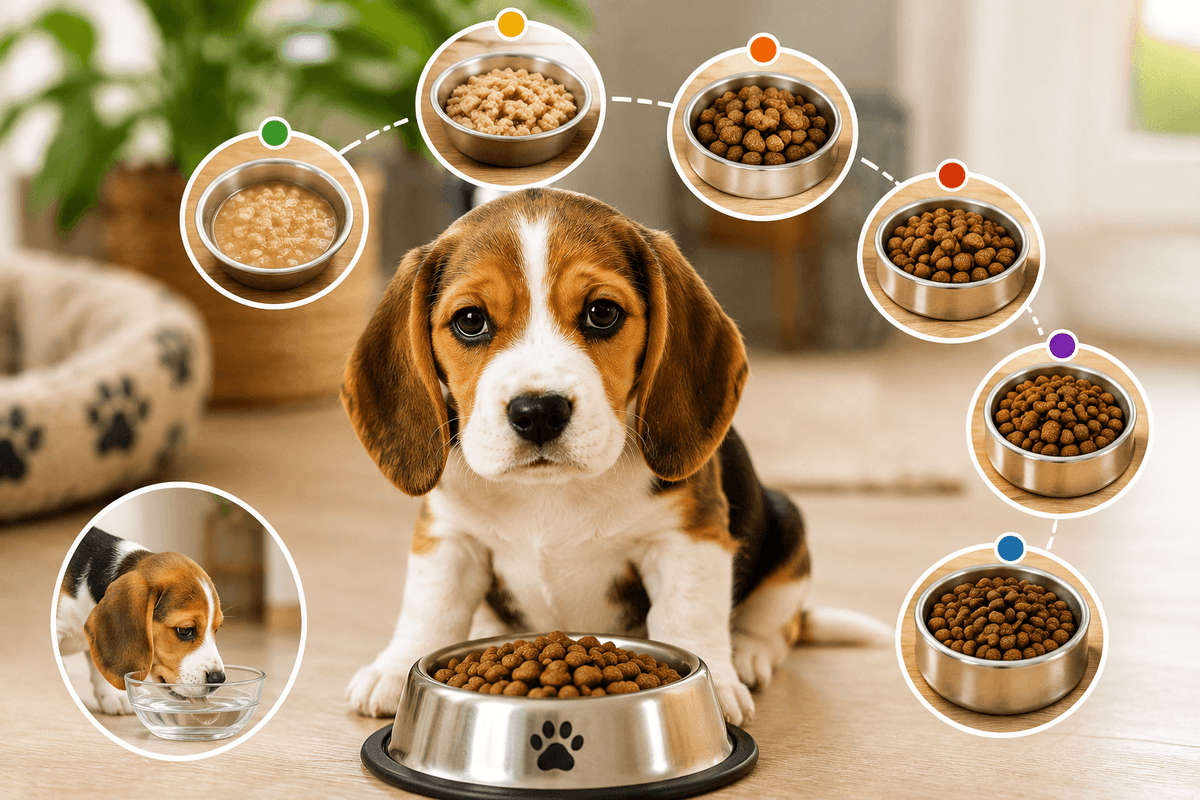
Beagle Puppy Feeding Guide (2026): What to Feed from 2 to 12 Months
A complete Beagle puppy feeding guide from 2 to 12 months — meal schedules, best foods, nutrition tips, and vet-backed advice from GoodFurs.

How to Buy a Beagle Puppy in India: The Complete First-Time Buyer's Guide (2026)
A complete step-by-step guide to buying a healthy, KCI-certified Beagle puppy in India — what to check, ask, and avoid before you pay.

Beagle Puppy Price in India (2026): What Affects the Cost of a Purebred Beagle?
Beagle puppy prices in India start from ₹15,000. Learn what affects cost, KCI pricing, hidden fees, and how to avoid overpaying or underbuying.
Frequently Asked Questions
Look for a square muzzle, large dark eyes, long low-set ears, a white-tipped tail, and a tri-colour or bi-colour coat that matches the breed standard. Cross-check these physical traits against KCI documentation and parent photographs — no single trait is proof on its own.