
Siberian Husky Colours in India: Black & White, Agouti, White & Blue Eyes Explained

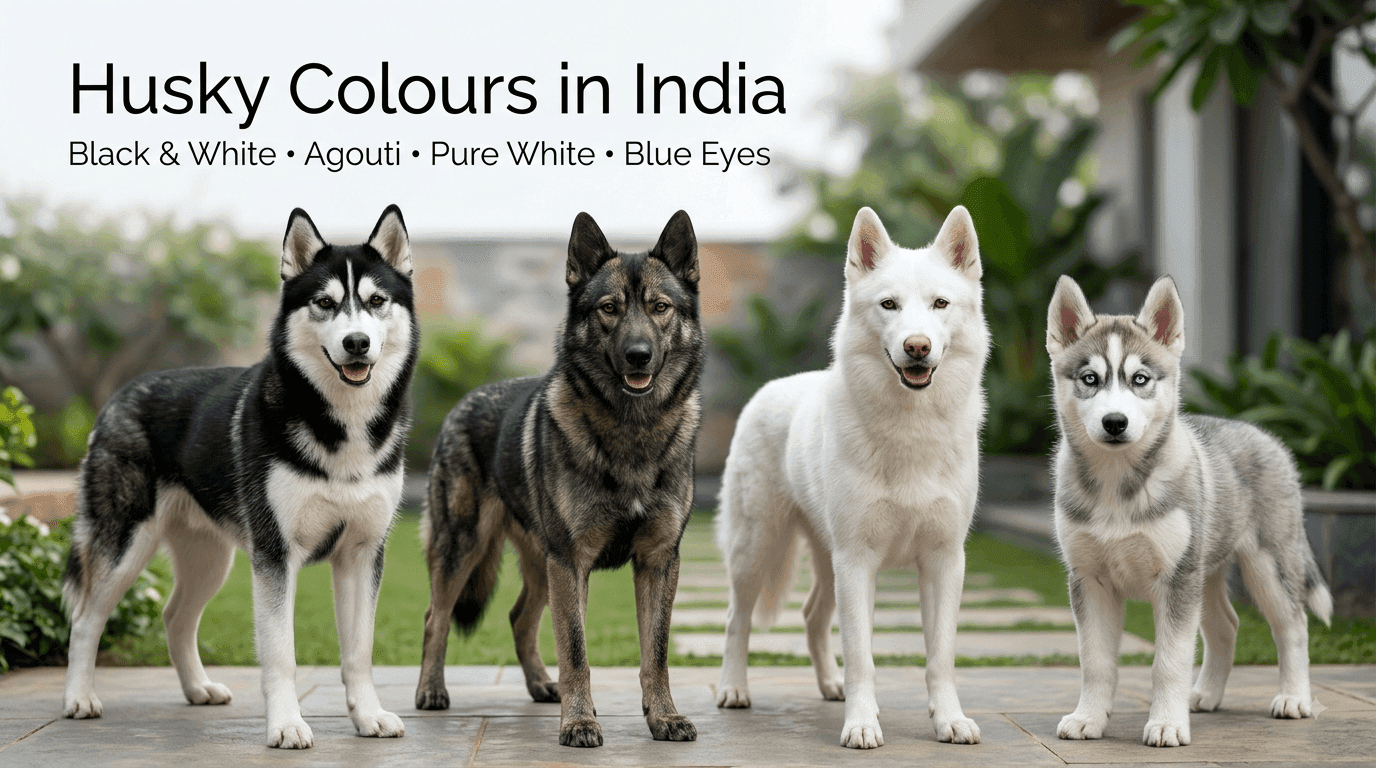
Siberian Huskies are one of the most visually striking dog breeds you'll come across, and it's usually their coat and eyes that catch a buyer's attention first. Walk into any Husky litter and you'll likely see puppies that look almost like different breeds — one with a classic black and white face mask, another with a darker, wolf-like agouti coat, and maybe one that's almost entirely white. All of them can be genuine Siberian Huskies.
For first-time buyers in India, this variation often raises questions. Is one colour rarer than another? Does a certain coat mean better health or higher quality? Do blue eyes make a Husky more special? This guide breaks down the major Husky colour and eye variations seen in India, and more importantly, explains what should actually guide your decision when choosing a puppy.
Quick Answer: What Are the Most Common Siberian Husky Colours in India?
The most common Siberian Husky colours found in India are black & white, grey & white, and agouti, with pure white and red & white Huskies being comparatively less common. Coat colour is a cosmetic trait and does not indicate a puppy's health, temperament, or breeding quality — these depend on the breeder's practices and the puppy's overall care.
What Colours Can Siberian Huskies Have?
Siberian Huskies naturally come in several recognised colour combinations, and most follow a similar pattern: a base coat colour paired with white markings, usually on the face, chest, legs, and tail tip.
Commonly seen variations include:
- Black & White — the most recognisable and widely available combination
- Agouti — a mixed, banded coat that gives a wilder, wolf-like appearance
- Pure or Predominantly White — minimal to no colour patches
- Grey & White — a softer, muted version of the black & white pattern
- Red & White — a warmer, copper-toned coat, less common in India
- Sable & White — a blend of red and black hairs, relatively rare here
It's worth being clear on one point early: none of these colours make a Husky a separate breed, and no colour is inherently "better" or "purer" than another. A reputable breeder will never claim that an unusual-looking coat automatically means higher quality — that's a marketing angle, not a fact about the dog.
Black & White Siberian Husky
This is the colour most Indian buyers picture when they think of a Husky. The coat typically has a black or dark grey back with a clean white underbelly, legs, and face markings, often including the classic "mask" pattern around the eyes.
Black & white Huskies are widely available across India and tend to be the easiest to source from responsible breeders. Eye colour in this variation can range from brown to blue, or even one of each. Buyers often prefer this combination simply because it's the most familiar Husky look, but familiarity shouldn't be mistaken for superior genetics — it's simply a common and well-documented colour pattern within the breed.
Agouti Siberian Husky
An agouti Husky has a coat where individual hairs carry bands of different colours rather than one solid tone, which creates a shaded, almost wolf-like appearance. The facial markings are usually darker and more pronounced, sometimes making the puppy look more serious or intense compared to a standard black & white pup.
Agouti is less commonly seen than black & white in India, which sometimes leads sellers to price it as a "rare" or "premium" colour. While agouti Huskies are less frequently bred here, rarity in supply is not the same as superior quality, and it should never be used as the sole justification for a significantly higher price. Temperament in agouti Huskies is no different from other colour variations — coat colour and personality are not linked traits.
Pure White Siberian Husky
A pure or predominantly white Husky has minimal to no dark patches, giving a near-solid white coat. This is different from albinism, which is a distinct genetic condition affecting pigment production throughout the body, including the eyes and nose.
Genuine white Huskies usually retain normal pigmentation on their nose and eye rims — a black or dark grey nose is common, though some can have a lighter "snow nose" that darkens with age or season. If a puppy shows signs of true albinism, such as pink eyes or a complete lack of pigmentation, that's a different situation and worth discussing directly with the breeder or a vet.
A white coat does not mean the puppy is healthier, rarer in genetic terms, or of better breeding stock. As with agouti, buyers should look past the colour and focus on vaccination records, parent health, and the breeder's transparency.
Siberian Huskies With Blue Eyes
Blue eyes are one of the most talked-about Husky traits, and yes — they are completely normal in the breed. Siberian Huskies carry a gene that can affect eye pigmentation independently of coat colour, which is why you'll see blue-eyed Huskies across black & white, agouti, and white variations alike.
Other eye colours in Huskies include brown, amber, and a lighter greenish-brown shade. None of these is more "correct" than the others from a breed-standard perspective, and eye colour has no proven connection to intelligence, temperament, or trainability. A blue-eyed Husky is not automatically a better quality puppy — it's simply a genetic variation that happens to be visually appealing, which is also why some sellers price it at a premium without real justification.
Can a Siberian Husky Have Two Different-Coloured Eyes?
Yes. This condition is called heterochromia, and it occurs fairly often in Siberian Huskies compared to most other breeds. A Husky with heterochromia might have one blue eye and one brown eye, or occasionally a split colour within a single eye.
Heterochromia in Huskies is generally a harmless genetic trait and not, by itself, a sign of a health problem. That said, buyers should still ask the breeder or a vet to confirm the puppy's vision is normal in both eyes, since eye-related issues can occasionally coexist with this trait. The presence of heterochromia alone is not something to worry about, but a basic eye check is still good practice before finalising any puppy.
Does Husky Colour Affect Price in India?
This is one of the most common questions Indian buyers ask, and the honest answer is: colour can influence price, but it shouldn't be the main factor driving cost.
Pricing for Husky puppies in India typically depends on:
- Pedigree and lineage
- Breeder reputation and ethical practices
- Health checks and vet certification
- Vaccination and deworming status
- Documentation, including KCI registration where applicable
- Age of the puppy at the time of purchase
- Location and delivery logistics
- Overall care and socialisation the puppy has received
A visually striking colour like agouti or blue-eyed white might carry a higher price tag simply due to demand, but an unusual coat alone should never justify a steep premium over a well-bred, healthy black & white puppy. If you're comparing costs across categories, it helps to check a dedicated resource like Siberian Husky Price in India for a clearer breakdown of what drives pricing city by city, including Delhi NCR, Mumbai, Bangalore, and Pune.
Which Husky Colour Is Best for Indian Buyers?
There's no single "best" Husky colour — the right choice comes down to personal preference, not genetic superiority. What should genuinely guide your decision is:
- Overall health and body condition
- Age-appropriate vaccination
- Deworming history
- Clear eyes and a clean nose, free of discharge
- Good coat condition without bald patches or excessive shedding beyond normal
- Evidence of responsible breeding practices
- Proper documentation
- The living conditions the puppy has been raised in
A healthy, well-socialised puppy in any colour will make a far better companion than one chosen purely for its looks.
What to Check Before Buying a Husky Puppy in India
Before you commit to a Husky puppy, regardless of colour, run through this checklist:
- Puppy's current health status and any visible symptoms
- Vaccination records and upcoming vaccination schedule
- Deworming history
- Health background of both parents, if available
- Living conditions at the breeder's facility
- How transparent the breeder is about documentation and questions
- Pedigree or KCI paperwork, where applicable
- Puppy's age — most reputable sellers won't release puppies before 45–60 days
- Transport and delivery arrangements, especially for long distances
- Whether the local climate is suitable for the puppy
For a more detailed walkthrough, this guide on how to choose a healthy Siberian Husky puppy covers each of these points in depth.
Are Huskies Suitable for the Indian Climate?
Coat colour has no bearing on how well a Husky handles Indian weather — a black & white Husky doesn't absorb more heat than a white one in any meaningful way that affects care requirements. What actually matters is heat management: proper ventilation, avoiding peak-afternoon walks, hydration, regular grooming to manage the double coat, and simply being a responsible owner in a warmer climate.
If you're based in a hot city and considering a Husky, it's worth reading through this detailed breakdown of whether a Siberian Husky and Indian climate combination works for your specific location and lifestyle before bringing one home.
Questions to Ask Before Buying a Husky Puppy
Before finalising a purchase, ask the breeder or seller:
- What is the puppy's exact age right now?
- What vaccinations has the puppy received, and what's still pending?
- Has the puppy been dewormed, and on what schedule?
- Can I see or get information about the puppy's parents?
- Is there any documented health history I should know about?
- Is KCI registration or pedigree documentation available?
- What are the puppy's current living conditions?
- What food has the puppy been eating, and can I get a transition plan?
- What delivery options are available to my city?
- Is there after-sale support if I have questions post-purchase?
A more complete version of this list is available in this guide on questions to ask a Husky breeder before buying.
Buying a Siberian Husky Puppy in India
Once you've decided on a Husky, the process should feel straightforward rather than rushed. Look for sellers who provide proper health documentation, a clear vaccination schedule, and are willing to answer detailed questions about the puppy's background rather than just pushing you toward a quick sale.
Marketplaces like GoodFurs work with verified breeders across India and can help with breed selection guidance, health verification, and delivery coordination, so buyers aren't left navigating the process alone. If you're actively looking, you can browse Siberian Husky puppies for sale in India to see currently available litters and their documentation.
Conclusion
Siberian Huskies come in a genuinely wide range of attractive coat and eye combinations — black & white, agouti, predominantly white, blue-eyed, and even puppies with two different-coloured eyes. Every one of these variations can belong to a healthy, well-bred Husky, and none is inherently better than the others.
Choose a Husky based on health, responsible breeding, documentation, temperament, and your ability to provide proper care — not simply because of coat or eye colour.
Ready to Bring Home a Husky?
If you're seriously considering a Siberian Husky puppy, take your time exploring available litters, ask breeders about health and vaccination records, and get guidance on which puppy genuinely suits your home and lifestyle. GoodFurs can help you connect with verified breeders, understand delivery options across India, and make a well-informed decision — without any pressure to rush your choice.
Most read




Frequently Asked Questions
Black & white and grey & white are the most commonly available colours in India, followed by agouti. Pure white and red & white Huskies are seen less often. Availability varies by breeder and region.